Roth Conversions vs. 0% Capital Gains: Which Should an Early Retiree Fill First?
PenaltyFreeRetire Editorial ·
Federal law checked Nov 11, 2026 · Covers 2026 rules · Next review Nov 30, 2026
Roth Conversions vs. 0% Capital Gains: Which Should an Early Retiree Fill First?
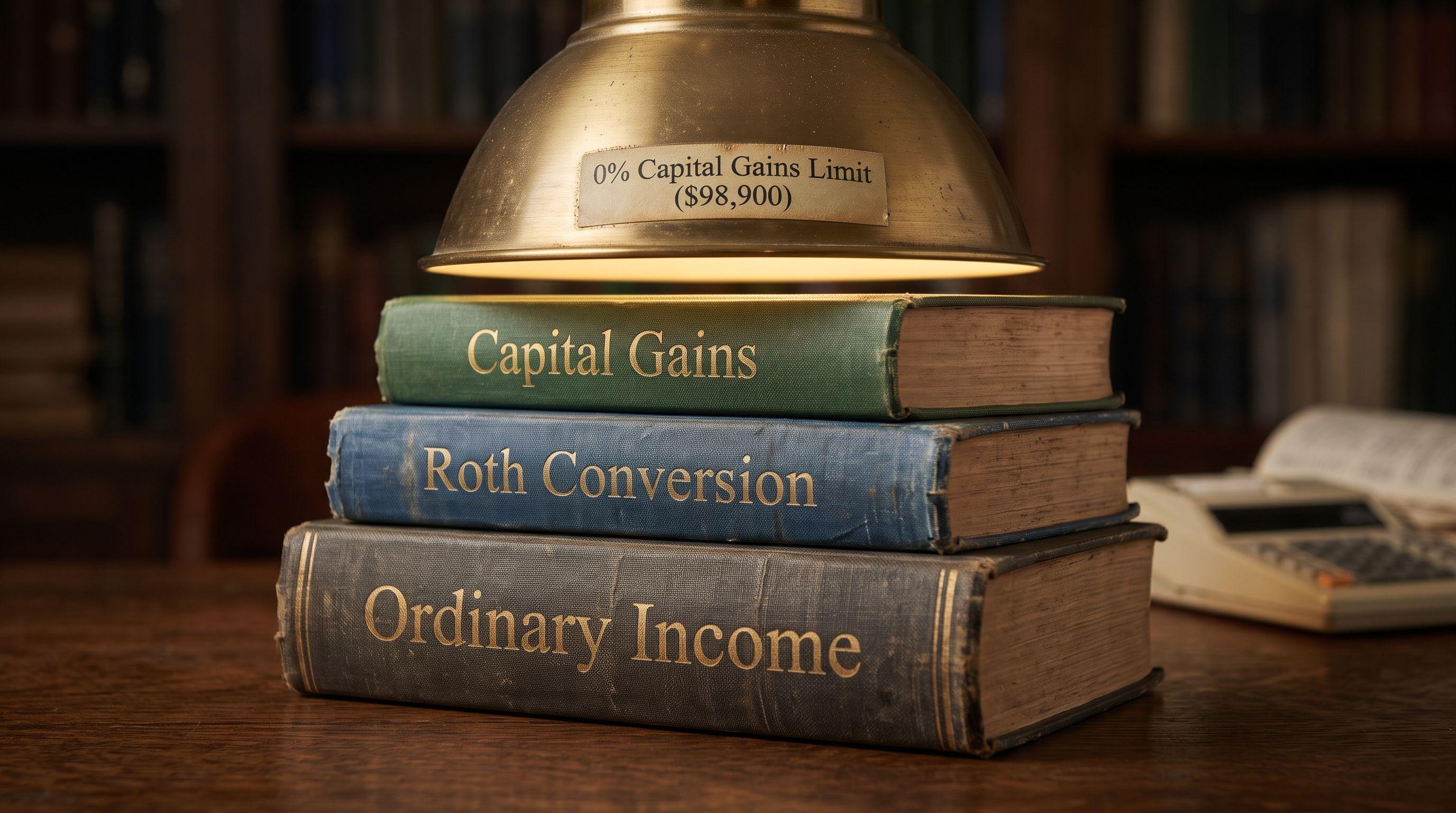
A Roth conversion and a 0% long-term capital gain do not use separate tax buckets. They share the same taxable-income stack. A larger Roth conversion can reduce the amount of gain taxed at 0%, even if the conversion itself stays inside a low ordinary-income bracket.
So which should an early retiree fill first? Harvest gains first when resetting a low basis is the immediate problem and you still have several years available for conversions. Favor Roth conversions when a large pre-tax balance, approaching required minimum distributions, or a short conversion window creates the bigger future tax risk. In either case, calculate both moves on the same tax return before placing the trade.
TL;DR: Start with projected taxable income, not the size of the conversion or stock sale. For 2026, the 0% long-term capital-gain ceiling is $98,900 of taxable income for married couples filing jointly and $49,450 for single filers. Ordinary taxable income, including the taxable part of a Roth conversion, fills the stack first. Qualified dividends and net long-term gains sit above it. Use the Roth Conversion Ladder Calculator for the conversion, then add dividends and planned gains to the same tax-year estimate.
Why a Roth conversion can shrink your 0% capital-gain room
The 0% capital-gain rate is based on taxable income. It is not a separate allowance for gains.
On the federal return, ordinary taxable income occupies the lower part of the stack. Qualified dividends and net long-term capital gains sit on top and receive the 0%, 15%, or 20% rate that applies at that level. The IRS uses the Qualified Dividends and Capital Gain Tax Worksheet or the Schedule D Tax Worksheet to do this calculation.
A taxable Roth conversion adds ordinary income. If the conversion raises the lower part of the stack, less room remains before long-term gains cross the 0% ceiling.
For 2026, the IRS set these maximum taxable-income amounts for the 0% long-term capital-gain rate:
- $98,900 for married couples filing jointly and qualifying surviving spouses
- $66,200 for heads of household
- $49,450 for single filers and married people filing separately
The threshold applies to taxable income after deductions. It does not mean a married couple can automatically realize $98,900 of gains at 0%. Wages, pension income, interest, short-term gains, taxable Social Security, Roth conversions, qualified dividends, and other income can use some or all of that room.
A 2026 example: the conversion creates a second tax cost
Assume a married couple files jointly, takes the $32,200 standard deduction, and has $40,000 of ordinary income before any Roth conversion. They also plan to realize $70,000 of net long-term capital gains. Neither spouse is 65, and the example ignores credits, state tax, and special deductions.
Without a conversion:
- ordinary taxable income is $7,800 after the standard deduction
- total taxable income is $77,800 after adding the $70,000 gain
- the full $70,000 gain remains below the $98,900 ceiling and is taxed at 0% federally
Now add a $30,000 taxable Roth conversion.
- ordinary taxable income rises to $37,800
- total taxable income rises to $107,800
- $8,900 of the gain now sits above the 0% ceiling and is taxed at 15%
That $8,900 spillover creates $1,335 of capital-gain tax. The conversion also increases ordinary federal income tax by about $3,260 under the 2026 married-filing-jointly brackets. The $30,000 conversion therefore adds about $4,595 of federal income tax in this simplified example, not merely the ordinary tax on the conversion.
This is why “fill the 12% bracket” can be incomplete advice. A conversion inside the 12% ordinary bracket can still push long-term gains out of the 0% band.
What if you have one income budget for both moves?
Suppose the same couple wants to add $90,000 of planned income to the year. The existing $40,000 of ordinary income and the $32,200 standard deduction stay the same.
They could choose either of these mixes:
- Convert $60,000 and realize $30,000 of long-term gains. Taxable income is $97,800. The gains stay at 0%, while federal tax on the ordinary portion is about $7,640.
- Convert $20,000 and realize $70,000 of long-term gains. Taxable income is still $97,800. The gains stay at 0%, while federal tax on the ordinary portion is about $2,840.
The second path saves about $4,800 of current federal tax. But it also leaves $40,000 more in the traditional account. The first path pays that tax now to move another $40,000 into Roth space.
That is the real decision. The lower current tax bill is easy to see. The value of a Roth conversion depends on the tax that the converted dollars would otherwise face later, how long the Roth can grow, and whether the traditional balance will create larger required distributions or taxable income in future years.
When Roth conversions deserve priority
A conversion can be the better use of the year when the pre-tax account is the larger problem.
That often means you have a substantial traditional IRA or 401(k), only a few low-income years before Social Security or required minimum distributions, and enough taxable cash to pay the conversion tax without withdrawing from the IRA. A surviving spouse may also face narrower single-filer brackets later, which can make carefully sized joint-return conversions more attractive now.
Do not convert merely because there is room in a bracket. Compare the current marginal cost with the likely future rate. The current cost includes any capital gains pushed from 0% to 15%, lost health-insurance assistance, state income tax, and other income-based effects.
If the conversion is part of an early-withdrawal plan, check the five-year timing and funding for the bridge. The Roth Conversion Ladder Calculator can model the conversion schedule, but the tax estimate still needs the household's dividends, gains, deductions, and other income for that year.
When capital-gain harvesting deserves priority
Harvesting gains can make more sense when the taxable account has large embedded gains and the household still has several future conversion years.
A 0% federal gain can raise the investment's basis. If you sell appreciated shares and promptly reinvest in a suitable investment, the realized gain becomes part of the new basis. A higher basis can reduce taxable gains on a later sale. Unlike a loss sale, a gain sale is not blocked by the wash-sale rule, though the trade can still change the portfolio and create market exposure between transactions.
Gain harvesting can also help an early retiree prepare a taxable account for future spending. Selling selected high-gain lots in a low-income year may leave more basis available for later withdrawals.
But 0% does not mean invisible. The gain still appears in adjusted gross income. It can affect Marketplace premium tax credits before Medicare, state tax, the taxable portion of Social Security, and other calculations tied to income. Read Can a Roth Conversion Raise Your ACA Premiums? before treating either a conversion or a harvested gain as free.
Checks that can change the answer
Run these checks before the conversion or stock sale:
- Qualified dividends use the same 0% and 15% rate bands as net long-term gains. Include dividends already paid and a reasonable estimate for year-end distributions.
- Capital-loss carryovers reduce net capital gain. Review the prior return before choosing the size of a gain harvest.
- Short-term gains are generally taxed as ordinary income. They do not receive the long-term 0% rate.
- The 3.8% net investment income tax can apply when modified adjusted gross income exceeds $250,000 for married couples filing jointly or $200,000 for single filers and heads of household.
- States do not have to follow the federal 0% rate. A federal 0% gain may still produce state tax.
- Marketplace savings use household MAGI. Capital gains and the taxable part of a Roth conversion can both raise that number.
- A large late-year move may require an estimated tax payment. The IRS treats federal income tax as pay-as-you-go.
Also confirm the cost basis and holding period before selling. The long-term rate usually requires holding the asset for more than one year, and the taxable gain is sale proceeds minus adjusted basis, not the full value of the sale.
A year-end order of operations
- Estimate ordinary income already received for the full year.
- Add expected interest, ordinary dividends, qualified dividends, capital-gain distributions, and any planned sales.
- Apply the deduction you expect to claim and estimate taxable income.
- Enter possible Roth conversion amounts and watch how each amount changes both ordinary tax and the capital-gain rate.
- Check ACA MAGI, state tax, capital-loss carryovers, Social Security taxation, and estimated payments.
- Choose the mix that solves the larger future problem without creating a current cost you did not intend.
Do this before placing the brokerage trade or completing the conversion. A conversion made after 2017 generally cannot be recharacterized back to a traditional IRA because the tax result was worse than expected.
FAQ
Is the 0% capital-gain rate based on AGI or taxable income?
It is based on taxable income. For planning, start with all income, account for above-the-line adjustments and deductions, then apply the long-term capital-gain rate bands. Do not compare the gain alone with the 0% threshold.
Does a Roth conversion count as ordinary income?
The taxable part generally does. If a traditional IRA contains nondeductible basis, Form 8606 determines how much of the conversion is taxable. You cannot usually isolate and convert only the after-tax dollars from one traditional IRA because the pro rata calculation looks across traditional, SEP, and SIMPLE IRAs.
Can I sell and immediately buy back an investment after harvesting a gain?
The federal wash-sale rule applies to losses, not gains. You can generally repurchase after realizing a gain, but check trading restrictions, transaction timing, and whether you actually want the same holding. The sale still creates a reportable gain.
Should I always use the entire 0% capital-gain band?
No. A gain can increase ACA household income, state tax, or another income-based cost even when the federal capital-gain rate is 0%. Realize only the gain that still works after those effects are included.
Do qualified dividends reduce the room for 0% long-term gains?
Yes. Qualified dividends and net long-term capital gains use the same preferential rate bands. Include both when estimating how much room remains.
Primary sources
- IRS Revenue Procedure 2025-32 in Internal Revenue Bulletin 2025-45
- IRS Publication 550, Investment Income and Expenses
- IRS Publication 590-A, Contributions to Individual Retirement Arrangements
- IRS Publication 505, Tax Withholding and Estimated Tax
- IRS Net Investment Income Tax guidance
- IRS Instructions for Form 8962, Premium Tax Credit
- HealthCare.gov Marketplace income guidance
This article is for education and planning. Federal and state tax results depend on the full return, account basis, filing status, deductions, and other household facts. Check the current IRS forms or work with a qualified tax professional before making an irreversible conversion or sale.
Official sources used for this article
- IRS Revenue Procedure 2025-32 in Internal Revenue Bulletin 2025-45
- IRS Publication 550, Investment Income and Expenses
- IRS Publication 590-A, Contributions to Individual Retirement Arrangements
- IRS Publication 505, Tax Withholding and Estimated Tax
- IRS Net Investment Income Tax guidance
- IRS Instructions for Form 8962, Premium Tax Credit
- HealthCare.gov Marketplace income guidance
Free email guide
Want the one-page Roth conversion version?
Get the cheat sheet by email. It covers bracket room, the 5-year wait, and the mistakes that tend to cost the most.
- How to estimate your bracket room before you convert
- What the 5-year rule actually means in practice
- The mistakes that quietly add tax, penalties, or bad timing
We store your email and optional first name in Supabase to send the guide and record your choices. Resend delivers the email. If you do not opt into updates, we delete the record 90 days after your most recent guide request. See our Privacy Policy. Educational only. Not tax or investment advice.
Try the calculator
Put this strategy into numbers with our free Roth calculator.
Open Roth Calculator →Related Articles
Can You Still Afford to Retire Before 65 in 2027?
Yes, retiring before 65 can still work in 2027. But you cannot have the health insurance part of the plan be a rough monthly guess. You need a local premium quote, an estimate of your 2027 Marketplace income, and enough room for deductibles and other costs before Medicare begins.
Should You Delay Social Security to Create More Roth Conversion Room?
Sometimes yes. Delaying Social Security can give you cleaner low-income years to move money from a traditional IRA to a Roth IRA. But that only helps if you already have a workable bridge for spending.
Can a Roth Conversion Raise Your ACA Premiums? How to Plan the Subsidy Tradeoff Before Medicare
Yes. A Roth conversion can raise your health insurance cost before Medicare. The reason is simple: the taxable part of the conversion increases your income for the year, and Marketplace savings are based on household income. That means the next conversion dollar can do two things...
What Are Required Minimum Distributions — and How to Delay or Reduce Them
Required minimum distributions generally begin at 73 for people born in 1951 through 1959 and at 75 for people born in 1960 or later. Here is how RMDs work, why they can raise taxes and Medicare costs, and what you can still do before they start.